



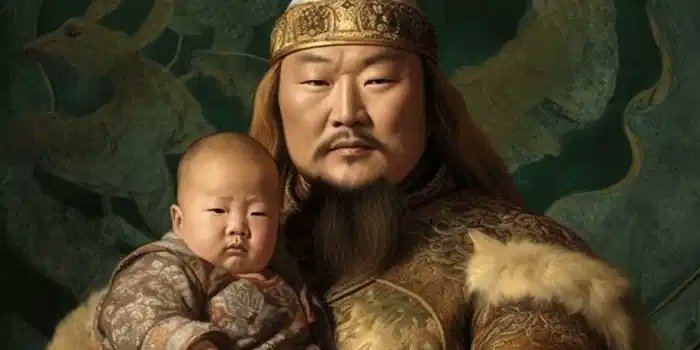


Most people searching for Genghis Khan’s family land on names like Ögedei or Kublai Khan. But one of his daughters held real governing authority over conquered Chinese territories and carried an official title that translated roughly as “Princess Who Runs the State.” Her name was Alakhai Bekhi, and her story is worth knowing.
This article covers who she was, how she fits into the Mongol imperial family, what her regency actually involved, and why her name keeps appearing in genealogy research today.
Who Alakhai Bekhi Was and Where She Fits in Genghis Khan’s Family
Alakhai Bekhi — also spelled Alakhai Beki or Alagai Bäki — was born around 1191. Historical records place her death only as “after 1230,” which tells you how incomplete the documentation is. Exact dates simply are not confirmed.
She was the third daughter of Genghis Khan (Temüjin) and his first wife, Börte. That makes her part of the core “Golden family” — the inner circle of Mongol imperial bloodline. Her brothers were Jochi, Chagatai, Ögedei, and Tolui, all of whom led armies and shaped the succession that followed Genghis Khan’s death.
One small correction worth making here: at least one popular YouTube video labels her as Genghis Khan’s granddaughter. That is incorrect. Wikipedia, genealogy records at GenealogieOnline, and other reliable sources consistently identify her as his daughter, born to Börte around 1191. The mix-up likely comes from how crowded and confusing the Mongol family tree can get, but the relationship is well established.
Her Two Political Marriages and What They Were Meant to Achieve
Alakhai Bekhi married twice, and neither marriage was a personal choice in the modern sense. Both were diplomatic tools, part of a larger strategy her father used to hold the empire together.
Her first husband was Jingue, an Uighur prince connected to the extended Mongol network. The Uighurs were important allies on the Central Asian frontier, and tying them to the Mongol ruling family through marriage gave Genghis Khan a stable buffer zone without needing a full military occupation.
When Jingue died around 1212, Alakhai did not simply return home. She married Boyaohe, another stepson within the same Uighur royal structure. This kept the alliance intact without interruption. The message was clear: the bond between the Mongol ruling family and the Uighur leadership would hold regardless of which individual held the title on either side.
Genghis Khan applied this logic broadly. He used daughters as alliance anchors at key frontiers, much the same way he used sons as military commanders. Daughters married into ruling families at the edges of empire; sons rode out to expand it. Alakhai was one of the clearest examples of how that worked in practice.
She had at least two sons from these marriages — Negudei and Chakhu — though detailed records about them are limited.
The Title “Princess Who Runs the State” and What It Actually Meant
When Genghis Khan withdrew from the territories he had conquered in China proper in 1215, he needed someone he trusted to govern them. He chose Alakhai Bekhi.
Her official honorific translated as “Princess Who Runs the State.” That was not a ceremonial label. It was an active administrative appointment. She functioned more like a governor-general or viceroy: someone with real authority to make decisions, but still operating under the ultimate sovereignty of her father.
This is an important distinction. She was not a queen ruling in her own right. She governed conquered territories on behalf of Genghis Khan, answering to him and working within the structure he had built. That is closer to a regent than a monarch.
Think of it this way: if Genghis Khan was the founder running a rapidly expanding enterprise, Alakhai was the trusted family executive sent to manage a major regional division after acquisition. She had genuine authority. She was not a figurehead. But the overall direction came from above.
Some modern retellings frame her as a warrior as well as an administrator. That framing makes for a compelling story, but primary sources do not clearly document battlefield participation. What is well supported is her role as a governor and diplomat. That alone is significant enough — governing a multi-ethnic conquered territory in 13th-century Central Asia was not a minor task.
According to the site Rejected Princesses, which profiles her in some detail, her administrative approach was later referenced by Ögedei, Tolui, and Kublai Khan when managing their own domains. That is an interpretive claim rather than a firmly documented historical record, but it does suggest her governance model left some kind of impression.
How Her Territories Fit Into the Wider Mongol Imperial Structure
Alakhai oversaw territories in northern China, likely areas that had previously been under Jurchen Jin control. These were not small patches of land. They were strategically significant regions that Genghis Khan needed administered while he focused on campaigns elsewhere.
Her governance sat alongside — not above — the military campaigns of her brothers. While she ran the administrative side of conquered Chinese territories, her brothers were leading armies and positioning themselves for the succession that would follow their father. It was a division of responsibilities that reflected the scale of what the Mongols were attempting to hold together.
What happened to her territories after her active role ended is not entirely clear. According to later historical reconstructions, the lands she governed were absorbed by Möngke Khan around 1253 and subsequently passed to Kublai Khan. Those details come from secondary interpretive sources, so they should be treated as one account of events rather than settled fact.
The length of her rule is also uncertain. Some estimates suggest it may have lasted roughly two decades, but the historical record is thin enough that a firm number is not possible. What does seem clear is that she held her position for a meaningful period — long enough to establish a functioning administration in a newly conquered region.
Why Her Name Appears in Genealogy Research Today
Alakhai Bekhi is not a household name. She does not appear in the same breath as Kublai Khan or Ögedei when people discuss Mongol history. But she turns up consistently in family tree research and genealogy databases, partly because of the broader fascination with Genghis Khan’s descendants.
The genetic studies suggesting that a significant number of people across Central Asia and beyond may carry lineage connected to Genghis Khan have driven a lot of interest in his extended family. When people start building out those connections on platforms like MyHeritage or tracing pedigrees further back, they often encounter her name in the branches.
For those interested in historical women who held real power — not in legend, but in administrative and political fact — she is also a compelling figure. She governed a conquered territory at a time when that was almost exclusively a male role. She did it through a combination of family authority, diplomatic marriage, and direct appointment from the most powerful ruler of her era.
Publications and profile sites that cover overlooked historical figures have picked up on that angle in recent years, which is part of why searches for her name have grown. For well-sourced context on figures who shaped history outside the usual spotlight, resources like Seismicbusiness cover a range of topics where history and public interest intersect.
What We Can Say About Her With Confidence
It is worth being honest about where the record ends and interpretation begins. Here is what reliable sources confirm:
- She was the daughter — not the granddaughter — of Genghis Khan and Börte, born around 1191.
- She held the title “Princess Who Runs the State” and governed conquered Chinese territories after 1215.
- She was married twice — first to Jingue, then to Boyaohe — both within the Uighur royal structure, for diplomatic reasons.
- She had at least two sons, Negudei and Chakhu.
- Her death is recorded only as “after 1230,” with no precise date confirmed.
What is less certain includes the full scope of her governing authority, the exact length of her rule, the fate of her territories, and any battlefield role. Modern blog posts and social content sometimes present her as a warrior princess with dramatic personal qualities. Those portraits make her more vivid, but they go beyond what primary sources actually say.
A Figure Worth Knowing
Alakhai Bekhi was not a background character in Mongol history. She was a deliberate political appointment, placed in authority over conquered territory by one of the most calculating rulers of the medieval world. The fact that she is less famous than her brothers says more about how history has been recorded than about the role she actually played.
She governed real land, held a real title, and served as a living diplomatic link between the Mongol ruling family and a key Central Asian ally. That is a meaningful historical footprint — even if the documents that might have captured the full detail of her life did not survive the centuries that followed.
Read Also: